Sunday, June 21, 2009

City Commissioners Vote to Buy Brownsville a Border Wall

On June 2, the Brownsville City Commission finally capitulated to the Department of Homeland Security’s demand that they give away city property to build the border wall. They had attempted to do this twice before, first last July and again this past February. In both instances the commissioners backed down in the face of widespread opposition from Brownsville residents. This time, however, they stuck with DHS, ignoring the will of the people by voting to give away the city’s land and to commit to build a border wall through Brownsville at the city’s expense. No other city has done so much to help build the border wall.

When the City Commissioners considered this deal last February, they issued a press release praising it, saying that
“The City of Brownsville is in the unique position to be the only border city between San Diego, California and the Gulf of Mexico to be offered the ability to remove the federally mandated border fence.” The Commissioners’ spin leaves out the fact that the initial border wall will only be removed after it is replaced with a border wall that will be far more permanent and imposing, and one for which Brownsville taxpayers will foot the entire multi-million dollar bill.

While the contract with DHS has been rewritten, the substance remains the same. The City of Brownsville will give up 15 acres of city property, which DHS valued at $123,100 when it initiated condemnation proceedings last September. The Department of Homeland Security will not pay a dime for the city’s land.


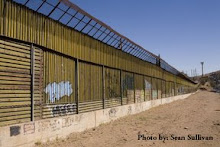
"Floating fence" border wall design in Cameron County, Texas

DHS will then build what they call a “floating fence” on the formerly city-owned property. While the City Commissioners may see the use of this border wall design as a victory, maps of the border wall released by DHS in July 2008 for their Environmental Stewardship Plan (ESP) clearly show “floating fence” on the city’s land. The ESP states, “Floating primary pedestrian fence consists of prefabricated floating fence panels placed on the levee. Floating fences are generally concrete barriers with pickets anchored on top.” This type of border wall has already been erected in parts of western Cameron County. So the floating fence is not a concession on the part of DHS, but what DHS had planned in the first place.

According to the contract, at some indefinite time in the future, the city will pay to build a levee-border wall in another unspecified location to replace the “floating fence.” It stipulates that the city must pay to buy the land for the new levee-border wall, and “construction shall be the responsibility of Brownsville, and shall not be performed by the United States or at any cost to the United States.” The bids for the levee-border walls in Hidalgo County ranged from $12 to $16 million per mile. Placing cost ahead of confidence in the quality of construction of our flood control levees, Hidalgo naturally went with the low bidder. Assuming that Brownsville does the same, the 2-4 miles of levee-border wall that will slice through the city will cost between $24 and $48 million, every dime of which must come from city coffers.


Levee-border wall under construction in Hidalgo County


Once Brownsville constructs the new levee-border wall, DHS will pay to take down the “floating fence.” Maybe. Homeland Security’s promise to pay to take down the first border wall is “subject to the availability of funding.” If they do not have the cash in hand, “then DHS shall provide Brownsville with appropriate access and authority to remove such sections and dispose of the removed material” at the city’s expense.

One new provision in the contract that the City Commission approved states that, “Brownsville shall, at its sole expense, preserve and maintain the Replacement Border Barrier.” So not only will Brownsville’s taxpayers have to pay to build a levee-border wall that none of them want, they must also pay to maintain it for decades to come.

Of course, it is unlikely that Brownsville will be able to come up with all of this money, so the “temporary” border wall will in fact be permanent.

But if they do, and private developers come through with millions more to build a riverwalk, we can look forward to long lines of tourists waiting to show their passports to go through the border wall to reach the trendy restaurants on the other side. What could be more appealing than fine dining in a no-man’s land that the Department of Homeland Security has walled off to keep “terrorists and terrorist weapons” from entering the rest of the United States?


Levee-border wall at the Old Hidalgo Pumphouse World Birding Center in Hidalgo County

Even if everything goes as the City Commission hopes, this deal defies all logic. It is as if someone took away your home, and rather than fight in court to either stop them or force them to pay you its market value of $123,100, you offered to buy them new land and build them a new house that would cost anywhere from $24 to $48 million, and you would then pay to maintain it. Accepting such a deal would certainly put you in a “unique position.”

Yet, this is the deal that Brownsville City Commissioners Anthony Troiani, Edward Camarillo, Ricardo Longoria, and Leo Garza voted to accept. Charlie Atkinson, who is a Border Patrol employee, abstained. Commissioner Carlos Cisneros and Mayor Pat Ahumada voted to reject it.

When public funds are used to build schools, hospitals, or other structures for the benefit of taxpayers, the politicians who approved the project can be counted on attend a ribbon-cutting ceremony and place a plaque telling future generations of their accomplishment. If the City of Brownsville manages to pull funds from schools, hospitals, or other projects to build the levee-border wall, I trust that the City Commissioners who voted for it will be on hand for the dedication ceremony. They can smile and wave and shake hands with the grateful residents of Brownsville, who will sleep better knowing that the border is no longer broken, that floods of terrorists no longer wash over Brownsville, and that it was their City Commission that brought about this shining moment. Engraved on a bronze plaque that will be bolted to the concrete slab of the border wall will be the names:

Anthony P. Troiani

Edward C. Camarillo

Ricardo Longoria

Leo Garza

Tuesday, June 16, 2009

Supreme Court Fails to Restore the Rule of Law to the Border

The Supreme Court’s refusal to hear arguments that the waiving of all state, local, and federal laws to build the border wall is unconstitutional is a tremendous blow for border residents and the principle of the rule of law. We had hoped that the court would honor its obligation to examine the constitutionality of section 102 of the Real ID Act, which is an unprecedented power grab by the Executive branch, and which creates unequal legal protections for U.S. citizens that are solely dependant upon what part of the country one lives in. In this instance the Supreme Court shirked its duty, leaving the border without the benefit of the rule of law that is enjoyed by the rest of our nation.

Section 102 of the Real ID Act allows for the suspension of all laws to build the border wall, stating, “Notwithstanding any other provision of law, the Secretary of Homeland Security shall have the authority to waive all legal requirements such Secretary, in such Secretary’s sole discretion, determines necessary to ensure expeditious construction of the barriers and roads under this section.” No other United States citizen is granted this extreme power under any circumstance. Even the president does not have this power to waive our nation’s laws, no matter what crisis may arise.

When former Homeland Security Secretary Chertoff waived 36 federal laws in April 2008, he knew that in building border walls he would be violating those laws. Obeying the law is not voluntary, it is mandatory. In a nation of laws all laws must be respected, not just those that are convenient. Those laws were enacted to prevent the kind of damage that we see everywhere border walls have been built.

For plaintiffs such as the Frontera Audubon Society, the Friends of the Wildlife Corridor, and the Friends of Laguna Atascosa National Wildlife Refuge, the fate of the Lower Rio Grande Valley National Wildlife Refuge is of particular concern. Consisting of individual tracts of native habitat linked by the Rio Grande, it creates a wildlife corridor, providing federally endangered species such as the ocelot and jaguarundi sufficient territory to find food, water, and mates. Migratory birds also rely on it to rest and refuel on their annual journeys, as well as for nesting. The border walls that have been built, and those that are still under construction, slice through many refuge tracts and cut off others from the river. The wall is fragmenting habitat, blocking migratory pathways, denying animals access to fresh water, and isolating breeding populations of endangered ocelot and jagurandi. Because the Endangered Species Act, the Migratory Bird Treaty Act, the National Wildlife Refuge System Administration Act, and the National Environmental Policy Act were among the 36 federal laws that the former Secretary swept aside, none of the usual legal protections for these supposedly protected lands remain.

In addition, Texas border communities depend upon the Rio Grande for irrigation and drinking water. But former Homeland Security Secretary Chertoff waived not only the Safe Drinking Water Act and the Clean Water Act, but also “all federal, state, or other laws, regulations and legal requirements of, deriving from, or related to the subject of” those, and 34 other, laws. So where the wall has been built, in El Paso and Eagle Pass and Hidalgo and Brownsville and other border communities that draw water from the Rio Grande, all laws “related to the subject of” water are no longer in effect. This absurd situation prompted the El Paso County Water Improvement District No. 1 and the Hudspeth County Conservation and Reclamation District No. 1 to take part in the challenge to the constitutionality of the Real ID Act’s waiver authority.

Equal protection under the law is meant to be a fundamental right shared by every American, but the Real ID Act makes the legal rights of citizens who live near the border conditional on the whims of an unelected Administration appointee. The Secretary of Homeland Security cannot waive the laws that protect citizens who live away from the border. Only border residents may have their legal protections waived.

When the Supreme Court decided not to hear these arguments without uttering so much as a word as to why, they shirked their duty as the final arbiters of the United States constitution and the principle of the rule of law that it enshrines. This precedent bodes ill for the rest of the nation, as any manufactured crisis may be used to enact a similar waiver. A “broken” northern border may be the pretext for a new bill waiving laws along the Canadian boundary, or an “energy crisis” may provide a convenient excuse to do away with laws that prevent drilling in the Arctic National Wildlife Refuge. The Supreme Court’s inaction will likely have repercussions beyond the destruction wrought by the border wall.

Thursday, June 4, 2009

No More Deaths Volunteer Convicted of Littering for Leaving Water in the Desert

The group No More Deaths has been working to save immigrants who are funneled into the Arizona desert by the border wall. In 2006, even before the Secure Fence Act led to the construction of hundreds of miles of Arizona border wall, the Government Accountability Office found that immigrant deaths had doubled as a result of the first walls built in California. A number of No More Deaths volunteers have been charged with littering for leaving water for border crossers. In the Arizona desert, where summer temperatures regularly top 110 degrees, it is virtually impossible to carry sufficient water. No More Deaths issued the following press release regarding the conviction of one of their members for leaving water in the desert for migrants:

Humanitarian Who Left "Life-Sustaining Water" for Migrants Convicted of “Littering”

Walt Staton, a volunteer with the Tucson-based humanitarian aid group No More Deaths, was convicted today of "knowingly littering garbage or other debris" after he left clean drinking water for undocumented migrants crossing the desert on the Buenos Aires National Wildlife Refuge.

In response to this verdict, No More Deaths released the following statement:

“This is a sad day for human rights and for all of us in southern Arizona. By penalizing life-saving work, the United States is showing callous disregard for the lives of our neighbors to the south, whose only crime is to seek a better life. No More Deaths will continue to provide life-saving aid to those in need, and to do our part to clean up the desert. The era of border enforcement that uses death and human rights abuses as a deterrent must come to an end.”

After more than four hours of deliberation on Tuesday afternoon and Wednesday morning, the 12-member jury first stated to the court that they were not able to agree upon a verdict. Magistrate judge Jennifer Guerin then ordered the jury to go back and attempt again to reach a unanimous verdict. Staton's attorney, William Walker, objected to the order, stating that it was coercive to the jury. The jury reconvened and met for less than an hour before returning a guilty verdict.

On December 4, 2008, U.S. Fish and Wildlife officer James Casey cited Staton and three other humanitarians for littering after being contacted by Border Patrol agents who were following the volunteers. The US Attorney’s office later dropped the charges against the other three. Staton refused to accept guilt and pay the original $175 fine. He now faces the punishment of this criminal misdemeanor that could include up to one year of prison time and a large fine. Sentencing is set for August 11.

In Staton's court testimony, he said that he was compelled by his personal experiences of encountering severely dehydrated migrants in distress. He also explained how the organization uses a strategic system of maps and GPS equipment to place the water in strategic locations. "We try to be conscious as an organization to be the most effective in order to save lives," stated Staton during examination.

During closing arguments, defense lawyer Bill Walker held a full gallon jug of water in the air and declared: "When the government tells you this case isn't about water or this isn't about saving lives, they're wrong! This is valuable, life-sustaining water."

During jury selection nearly one third of the original 31 potential jurors were dismissed after stating they had strong emotions about providing humanitarian aid to migrants and would be unwilling to convict someone who was engaged in humanitarian aid. Public support was also evident during the two full days of the trial as the courtroom remained full with 40-50 humanitarian supporters from local groups such as The Samaritans, Humane Borders, American Friends Service Committee and the Unitarian Universalist Church of Tucson, among others.

Dan Millis, a fellow No More Deaths volunteer, received a similar ticket in February, 2008, for leaving water jugs on the Buenos Aires National Wildlife Refuge. Millis was found guilty last September after a bench trial before magistrate judge Bernie Velasco in Tucson. Dan appealed the case to the US District Court, where the original ruling was upheld. It is currently under appeal at the 9th Circuit Court. Staton also plans to appeal his case to the 9th Circuit.

“The Buenos Aires leadership needs to realize that we’re on the same team here,” Millis said. Millis works full-time for the Sierra Club’s Borderlands Protection Campaign. “They need to issue more permits allowing humanitarian groups to provide water and pick up trash on the refuge,” he said.

Letters of support for Walt Staton, Dan Millis and No More Deaths can be sent to media@nomoredeaths. org; they will be posted on our web site.

* Background on No More Deaths:

According to Pima County medical examiner's data, approximately 20 bodies of deceased migrants have been recovered from Buenos Aires National Wildlife Refuge since 2002. Dehydration is a factor that leads to many of these deaths. More than 5,000 bodies have been recovered from the US/Mexico border as a result of the U.S. Border Patrol’s strategy of deterrence, beginning in 1994 with Operation Gatekeeper.

Since 2004 No More Deaths has provided life-saving aid to migrants in distress along the Arizona/Mexico border. Thousands of volunteers have participated in these efforts, which include providing water, food and medical assistance. No More Deaths is a ministry of the Unitarian Universalist Church of Tucson and seeks to work with other religious groups, government, community partners, and individuals willing to work toward an end to the humanitarian crisis occurring in the Arizona desert.

No More Deaths is currently gearing up for its sixth summer of humanitarian action during the hottest, deadliest months of the year. We are accepting volunteer applications for the summer, and welcome any and all donations to support our work!

For an updated list of migrant deaths in Arizona, visit DerechosHumanosAZ. net.

Please take a moment to sign the following e-letter to participate in an international campaign declaring that "Humanitarian Aid Is Never A Crime!” This letter speaks to a case in which the Italian government is prosecuting two Germans for "smuggling" after they rescued a sinking raft in the Mediterranean Sea with 37 African refugees on board. Such prosecutions resonate with the efforts by the United States government, described above, to criminalize life-saving humanitarian work.

Sunday, May 24, 2009

Will Congress Restore the Rule of Law or Build More Border Walls?

By Scott Nicol

The walls that are tearing through border communities and wildlife refuges have nothing to do with national security, immigration policy, or drug control. The construction of border walls merely allows for political posturing during election cycles. Politicians and pundits decry our nation’s “broken borders,” and blame undocumented immigrants for all of our nation’s ills, from unemployment to failing schools to municipal budget shortfalls to crime. Scapegoats are convenient, especially when they cannot vote, and scapegoating distracts voters from politicians’ inability to solve any of these problems. And so, two weeks before the 2006 mid-term election, the Secure Fence Act was signed into law. Two an a half years later the walls that it mandated are nearing completion, and we as a nation must decide what happens next.

One path forward was proposed by Representative Raul Grijalva, whose southern Arizona district is now home to mile upon mile of border wall. Last month he introduced the Border Security and Responsibility Act (HR 2076). This legislation seeks to prevent future border security measures from repeating the worst abuses that have accompanied border wall construction.

While the Secure Fence Act established walls as the primary strategy for controlling the border, the Border Security and Responsibility Act would instead, “give first priority to the use of remote cameras, sensors, removal of non-native vegetation, incorporation of natural barriers, additional manpower, unmanned aerial vehicles, or other low impact border enforcement techniques.” Border walls, which have been shown to be largely ineffective, go to the back of the line.

HR 2076 would also require the Department of Homeland Security to develop a comprehensive cost-benefit analysis, comparing the full range of possible strategies for protecting the border. Along with looking at whether border walls actually stop anyone, DHS would have to factor in land acquisition costs, construction costs, maintenance costs over 25 years, impacts on wildlife, impacts on hydrology, and the costs of mitigating adverse impacts to Federal, state, local, and private lands and waters. The costs and benefits of border walls would then be compared to similar analyses of adding more Border Patrol agents, so-called “virtual” fences, natural barriers, removing non-native vegetation, and increasing cooperation with Mexican and Canadian authorities.

Sign on private property near Brownsville, Texas that will be cut off by the border wall.

Rather than shutting out border residents and other stakeholders, Rep. Grijalva’s bill would require the Secretary of Homeland Security to consult with other federal agencies, tribal governments, local officials, and private property owners to minimize the negative impacts of border security measures. Real consultation that allows for meaningful input from those who live and work along the border would be a tremendous change for the better.

Most importantly, it would strike the provision of the Real ID Act that gives the Secretary of Homeland Security the power to waive any law that he or she sees fit in order to build border walls. No longer would one unelected Administration appointee have the power to sweep aside laws passed by Congress and signed by presidents. The rule of law would be restored along our nation’s southern border.

And this restoration is critical. When former Homeland Security Secretary Chertoff waived 36 federal laws last year, he was not simply cutting red tape. He knew that in building border walls he would be violating those laws. Those laws were enacted to prevent the kind of damage that we see everywhere border walls have been built.

In California’s Otay Mountain Wilderness Area, mountainsides above the Tijuana River are currently being dynamited to build the border wall. When DHS proposed building walls in these rugged mountains the Environmental Protection Agency raised concerns that the dumping of tons of rubble, and the erosion that would follow, would clog the river and violate the Clean Water Act. Normally that would be a moot point, because it is illegal to drive a motorized vehicle in a Wilderness Area, much less plant dynamite. But with the Wilderness Act and the Clean Water Act waived, blasting is occurring today, and will continue through the summer.

Texas border communities rely on the Rio Grande for irrigation and drinking water. But Secretary Chertoff waived not only the Safe Drinking Water Act and the Clean Water Act, but also “all federal, state, or other laws, regulations and legal requirements of, deriving from, or related to the subject of” those, and 34 other, laws. So where the wall has been built, in El Paso and Eagle Pass and Hidalgo and Brownsville and other border communities that draw water from the Rio Grande, all laws “related to the subject of” water are no longer in effect. This absurd situation has prompted the El Paso County Water Improvement District No. 1 and the Hudspeth County Conservation and Reclamation District No. 1 to take part in a lawsuit challenging constitutionality of the Real ID Act’s waiver authority.

"Floating fence" border wall design on top of the flood control levee in Cameron County, Texas

The border wall has been tremendously destructive, both to American lands, American communities and the American tradition of rule of law. But with most of the Secure Fence Act’s 670 miles of border wall close to completion, some might ask why the provisions of the Border Security and Responsibility Act are needed.

The answer came on the same day that Representative Grijalva introduced HR 2076, when Rep. Duncan D. Hunter introduced the Border Sovereignty and Protection Act. Apparently, Hunter Junior inherited the bad politics of his father along with his name and Congressional seat. His father bragged in campaign ads that he had built the border wall, and that it was a stunning success. Ignoring the question of why more walls are needed if the first walls had already done the job, Hunter Junior’s bill requires, “two layers of reinforced fencing along not fewer than 350 miles of the southwest border” in addition to all that has already been built. It also provides a blank check to pay for construction.

"Triple-layer fence" border wall design near San Diego, California

Grijalva’s bill requiring consultation, a cost-benefit analysis, and the restoration of the rule of law currently has 20 cosponsors. Hunter’s bill, requiring another 350 miles of double-layered border wall and providing unlimited funds to pay for them, currently has 26 cosponsors.

When the first sections of border wall were built in southern California in the mid 1990s, the Congressional Research Service found that they had “no discernible impact” on the number of undocumented immigrants who entered the United States each year. Rather than realize that the wall was a failure, border wall proponents, most notably Duncan’s dad, decided that the wall was not long enough. Now that another 600+ miles of border wall have been built, and the Border Patrol routinely refers to them as “speed bumps,” the cry goes up for more walls. In the perverse logic of those who have tied their political careers to the border wall, if the wall is a failure, it is simply because it is too short.

If this logic is allowed to prevail, mile upon mile of new border wall will be built with no concern for the communities or ecosystems that lay in their path. That is why passage of Representative Grijalva’s Border Security and Responsibility Act is so critical. It restores a degree of sanity to border policy, forces the federal government to respect the legal rights of border residents, and gives us a seat at the table when decisions are made regarding our home.

Friday, May 1, 2009

The Border Wall vs. Property Rights: Texas’ Senators Support the Wrong Side

by Scott Nicol

To build the border wall the federal government has brought condemnation lawsuits against more than 300 Texas landowners. Homeowners, farmers, nature preserves, and municipalities all face the imminent loss of their property for a patchwork of walls that have “no discernible impact” on the overall numbers of immigrants or smugglers who cross the border, according to the Congressional Research Service. The wall is a rhetorical point used by politicians who do not represent border communities to claim that they are working to protect the homeland. For them, the real impact of the border wall is irrelevant; all that matters is the perception among voters who will never actually see it. Members of congress who do represent Texas border residents should be fighting to defend our lands and our homes, literally the homeland that the border wall is supposed to secure. Instead, Texas’ Senators have worked to fund and build the wall that today stands in Hidalgo County and is tearing through Brownsville.

Land nearest the Rio Grande has always been prized because of the rich soil and the year-round availability of water. Many families along its banks still hold title to lands that were granted to their forefathers by the King of Spain as early as the 1740’s, decades before the United States and Mexico became sovereign nations, and more than a century before the Rio Grande became their shared border. For these owners, the land is a priceless piece of their family’s history.

Eloisa Tamez’ property has been in her family since the King of Spain issued the San Pedro Carracitos Land Grant in 1763. In 2007 DHS demanded access to her property for border wall surveys, then initiated condemnation proceedings. Dr. Tamez enlisted the Center for Human Rights and Constitutional Law and initiated a class-action lawsuit alleging that DHS has refused to negotiate with landowners before condemning their property, as the law requires. She also demanded that DHS reveal its criteria for citing the border wall, which in places runs for miles through poor and/or minority communities, then ends abruptly at the property line of wealthy property owners and resort communities. David Pagan of Customs and Border Protection responded, "We do not plan to suspend work on the construction of fence in order to hold a series of additional consultation meetings." On April 15, 2009 the court ruled against Dr. Tamez’, allowing the federal government to seize her land. Within a week the border wall had been built across her property.

Last February Eva Lambert awoke to the sound of heavy equipment erecting the border wall’s steel posts on her land. In her case, either through disregard for the law or incompetence, DHS finished construction of the wall before anyone had contacted her to negotiate a price or condemn her property. Denied her day in court as well as her property, Ms. Lambert is still waiting to find out what compensation will be offered. As she told the Brownsville Herald, "In the end, the government does what it wants."

In the low-lying river delta of South Texas, the treaty that established the Rio Grande as the border prohibits construction between the levee and the river. This is because a structure immediately adjacent to the river could deflect floodwaters and shift the river’s course, resulting in a change in the international boundary. So, to comply with the treaty, the border wall is being built into, on, or behind the flood-control levee that parallels the river rather than immediately adjacent to it. This levee is located up to two miles north of the river, leaving thousands of acres of U.S. territory, much of it privately owned, behind the border wall.

The Department of Homeland Security has offered only to pay for the exact footprint of the border wall (typically, a 60-foot wide strip) as it passes through a parcel of land. In their simplistic calculations, the agency has completely issues such as the devaluation of contiguous property, problems accessing land and homes behind the wall, impacts on livelihood, and the importance of cultural heritage. Despite the range and complexity of these issues, DHS has steadfastly refused to enter into meaningful negotiations with property owners.

The Nature Conservancy’s Southmost Preserve maintains one of the last remaining Sabal Palm forests along the banks of the Rio Grande. The border wall will bisect the preserve, cutting off more than 700 acres along with an equipment barn, office, and caretaker’s residence. The property was purchased in 1999 for $2.6 million, but DHS has only offered to pay $114,000 for the wall’s footprint, a strip of land 60 feet wide and 6,000 feet long. DHS has refused to explain how they will access the property that will be behind the wall. They claim that gates will be built, but they won’t say who will get keys or under what circumstances Conservancy staff will be able to access the property. Like Dr. Tamez, the Nature Conservancy is attempting to use the courts to save their land.

Other homes, businesses, and properties that are behind the levees will be walled off entirely, trapped between the wall and the Rio Grande. DHS has refused to grant any compensation whatsoever for properties left on the “Mexican” side of the wall. Indeed, because DHS is focused solely on the wall’s exact footprint, they have failed to even make contact with some of the landowners with property behind the wall.

The Sabal Palm Audubon Center preserves another 557 acres of Sabal Palm forest, which will also be behind the border wall. Because the wall will be built a few feet to the north of their property line, DHS has not offered Audubon any compensation whatsoever. Both Audubon and the Nature Conservancy have said that restricted access for their employees may force them to cut their operations. There is also the concern that uncertain access for emergency personnel may make it impossible to purchase the insurance that allows busloads of local school children to visit the center. With construction of the border wall imminent, Audubon announced that on May 15, 2009 they will close to the public for at least the next 6 months.

The Department of Homeland Security has repeatedly claimed that they have consulted with landowners and local officials regarding border wall construction. But when the Texas Border Coalition repeatedly invited DHS and Customs and Border Protection officials to “walk the line and see the impacts that the border wall will have on specific communities, they responded that they would only do so if the owners of the property that they would be crossing were kept away. Apparently, their preferred method of consultation is a condemnation proceeding.

In the face of these assaults on property rights by the federal government, one would expect Texas’ conservative Senators to stand up for their constituents. Private property and small government are central tenets of both of their stated philosophies. In July of 2007 Senator Cornyn told reporters, "I assure you there will be local consultation. There will not be ... unilateral actions on the part of the Department of Homeland Security without local input."

Senator Hutchison did add an amendment to the 2008 Omnibus Appropriations Bill that gave the Secretary of Homeland Security the flexibility to decide where walls should be built, as well as to spare places where walls do not make sense. The Homeland Security Secretary was also required to, “consult with the Secretary of Interior, the Secretary of Agriculture, States, local governments, Indian tribes, and property owners in the United States to minimize the impact on the environment, culture, commerce, and quality of life for the communities and residents located near the sites at which such fencing is to be constructed.”

Following howls of outrage from right wing pundits and politicians that she had “gutted” the Secure Fence Act, Hutchison backed away from her amendment. She has yet to confront DHS on its refusal to consult with property owners, as epitomized by its demand that landowners be kept away from any DHS employees who walk the line through their property. So long as she is afraid to fight on behalf of Texas landowners, the amendment that she authored is just more empty words.

Senator Cornyn’s statements assuring that there will be local consultation have also proved to be empty. Like Senator Hutchison, he has made no concrete effort to stand up for border residents. Instead, Cornyn sponsored the “Emergency Border Security Funding Act of 2007” which called for 700 linear miles of border wall and 300 miles of vehicle barriers along the US – Mexico border, and provided $3 billion dollars to build it. Cornyn’s bill went nowhere, but even without it DHS has received $3.1 billion to build the border wall.

On April 2, 2009, the one year anniversary of former Homeland Security Secretary Chertoff’s border-wide waiver that swept aside 36 federal laws, both of Texas’ Senators voted to add a motion to the Omnibus Appropriations bill that read, “To provide for a point of order against any appropriations bill that fails [to] fully fund the construction of the Southwest border fence.” The vote fell along party lines and failed, but in voting once again in favor of the border wall Hutchison and Cornyn chose party loyalty over the interests of their constituents.

This should not come as a surprise. When Cornyn looks back at the last election, he will look to the north Dallas suburbs as important to his win, not 540 miles south of Dallas to Brownsville. When Hutchison thinks about her upcoming bid to unseat Governor Perry, she will be counting on votes in Sugarland, not El Paso. Though they claim to represent the entire state, so long as they see border communities as politically irrelevant they will not work on our behalf.

The fact that their neglect is not surprising does not make it acceptable. Our Senators, as well as our U.S. Representatives and our President, were put in office to work for all of us. They can not be allowed to play favorites. When they do we need to speak up.

Some border representatives are working to defend border communities. Representative Grijalva of Arizona has authored HR 2076, The Border Security and Responsibility Act. It would require that the Department of Homeland Security work with border communities and landowners in developing security measures, rather than treat them as the enemy. DHS would also have to obey all of our nation’s laws, instead of sweeping away those which are seen as an inconvenience. Cosponsoring this bill in the House, or introducing a companion in the Senate, would be a concrete demonstration of support for border residents.

With this bill pending and walls under construction, it is critical that our members of Congress hear from their constituents right now. Urge them to support the Border Security and Responsibility Act. Demand that they work to stop further walls from tearing through the borderlands. Though only around 50 miles of border wall remain to be built it is not too late to stop it. If you lived in a home, or owned a farm, or worked at a wildlife refuge that is in the path of one of those miles, you would see every last mile as important.

So long as we sit quietly by and watch the border wall go up, we are irrelevant in the eyes of Congress. If we do not make our voices heard, and make our elected officials listen, mile upon mile of wall will be built. And while we can rail against the politicians who sacrifice our home for political gain, if we are silent we own a portion of the blame.

Thursday, April 23, 2009

Grijalva Introduces Legislation to Protect and Conserve Public Lands along Border

US Representative Raul Grijalva has introduced legislation which would reverse some of the worst abuses of the Department of Homeland Security's implementation of the Secure Fence Act and the Real ID Act. Below is the press release issued by his office.

Washington, D.C. – Today, Congressman Raúl M. Grijalva introduced legislation that will help secure and conserve public and tribal lands along the international land borders of the United States.

The Border Security and Responsibility Act of 2009 will secure and conserve federal public lands along the international land borders of the U.S. and provide the highest protection possible while ensuring that all operations necessary to achieve border security are undertaken.

The legislation will also help mitigate damage to federal and tribal lands from illegal border activity and border enforcement efforts by increasing coordination and planning between the Department of Homeland Security (DHS), federal land management agencies and local, state and tribal governments.

The legislation will also correct existing policies and allow flexibility for a local approach to border security, instead of mandating an unrealistic and harmful wall.

“Current policy has driven crossing activity to remote isolated areas along the border which, in Southern Arizona, represent significant public and tribal lands,” said Grijalva. “Many of these lands have suffered extensive environmental degradation as a result of unauthorized activity and border security efforts. This bill is the first step in preserving our unique natural heritage while we protect our borders.”


The Border Security and Responsibility Act of 2009 will:

1. Require the Department of Homeland Security to consult with federal land managers and state, local, and tribal governments in creating a Border Protection Strategy that supports border security efforts while also protecting federal and tribal lands.

2. Provide for flexibility, rather than a “one size fits all” approach, to border security by allowing experts at DHS to decide upon best strategies for border security.

3. Allow land managers, local officials, and local communities to have a say in border security decisions, requiring full public notice and participation.

4. Ensure that laws intended to protect air, water, wildlife, culture, and health and safety are fully upheld.


Under the Bush Administration, the passage and implementation of the Secure Fence Act and REAL ID ignored environmental, health and safety laws that had been in place for decades. The Border Security and Responsibility Act amends the current law, which pursues a “one fence fits all” solution. The legislation ensures that local experts are part of the planning and evaluation of security measures that would be more effective and have a lower impact on the border environment.

“This multi-disciplinary approach is the correct path for addressing a growing crisis in a rapidly changing geopolitical reality,” stated Grijalva. “The Border Security and Responsibility Act will strengthen border security, protect the environment and uphold the health of the border community by allowing all agencies to work together cooperatively.”

Sunday, April 5, 2009

Secretary Napolitano Must End DHS’ Abuse of Texas Border Communities

By Stefanie Herweck


Over the past two years, the Department of Homeland Security (DHS) and the organizations that it manages, Customs and Border Protection (CBP) and the Border Patrol, have shown a deep-seated indifference to the welfare of those of us living on the Texas-Mexico border. These agencies have treated our elected leaders with disrespect, they have assumed an adversarial relationship with the public, and they have shown disdain for border communities, culture, and the environment. These actions have seriously undermined DHS’s credibility along the Texas border and have fostered a great deal of antagonism.


The border wall is the clearest example of this. The border wall project has been propelled by a blind determination to build as many miles of wall as possible regardless of cost, safety, effectiveness, and environmental damage. It has been shrouded in secrecy, and DHS has purposely obfuscated time and time again, as though border residents have no right to know what is happening in their communities and even on their own property.


Levee-border wall in Hidalgo County, Texas February 22, 2009


In June 2007, they started with a lie to the Texas Border Coalition. Texas border mayors and other community leaders were assembled to hear details about the border walls that would run through their cities. Border Patrol Chief David Aguilar told them that he could give them few details because even though he had attended the signing ceremony for the Secure Fence Act nine months earlier, the border wall plans were still sketched on “the backs of napkins.” At the exact same time in another location, the Border Patrol held a private meeting with landowners, during which detailed maps of the proposed route of the wall were displayed.


DHS lied again in order to comply with legislation that requires local consultation. When ask to submit proof of the “18 town hall meetings” that they claimed to have held, they listed random phone calls and lunch meetings with single individuals, but no actual town hall meetings.


Then, in the ultimate act of negligence, DHS decided that border residents should not be protected by the laws that govern the rest of the country, and Bush Administration Secretary Chertoff waived 36 federal laws in order to slam the border wall through the Texas borderlands regardless of its impact on public safety and the environment. The Safe Drinking Water Act, National Environmental Policy Act, and others that protect the rest of the nation no longer apply where the wall is being built.

Border wall "pickets" in front of the wall in El Calaboz, Texas March 14, 2009


Yet another DHS policy revealed this same disregard for public safety. Shortly before hurricane season last year, the news broke that in the event of a hurricane making landfall in the Rio Grande Valley, the Border Patrol intended to check documents of every Valley resident seeking to evacuate or seeking entrance into a shelter. According to Border Patrol’s plans, anyone without the proper documentation would be immediately arrested and placed in a detention facility.


Worried that this policy would cause a bottleneck at the checkpoints and the unjustified arrests of citizens fleeing in haste without documents, border leaders and residents decried the practice. Advocates for colonias complained that it unfairly risked the safety of the poor, elderly, and those with limited English who would be afraid to evacuate. Since many people would be unwilling to leave their undocumented family members, this policy could mean many thousands of people left in the path of a deadly storm.


In the face of criticism that DHS was willing to put so many human lives in jeopardy, and the perception that they might even be taking advantage of a natural disaster to make more arrests, Secretary Chertoff downplayed the policy and said that the Border Patrol would not impede evacuations. However, when Hurricane Dolly bore down on the Rio Grande Valley in July 2008, the Border Patrol continued to arrest undocumented immigrants who tried to pass through the checkpoints.


Although there has been a change in administration, the agency is still primarily staffed by the same officials that crafted and implemented DHS's stance during the last administration. Among them is the CBP employee who in February gave the Brownsville City Commissioners an arbitrary deadline to accept a border wall deal. The deadline was later repudiated by Secretary Napolitano, who had not been informed of it, after U.S. Representative Ortiz intervened on Brownsville’s behalf.


Under the Obama administration, DHS has also maintained its indifference toward the landowners whose properties are being directly affected by the construction of the border wall. Having long refused to provide landowners and their elected officials with a detailed border wall plans, they sabotaged yet another opportunity to explain where and how the wall will be built when they refused to “walk the line” with the Texas Border Coalition in February. DHS said that they were willing to visit a very few of the properties where the border wall would be built with TBC, but the property owners must be kept away.


Border wall behind a home in Cameron County, Texas March 14, 2009


In perhaps the ultimate act of disrespect to landowners, as well as evidence of sheer incompetence and unprofessionalism, last week brought news that DHS usurped one Cameron County resident’s property for the border wall without a contract and without offering compensation. Eva Lambert woke up one morning to find the border wall being constructed across her backyard. It wasn’t until after the wall on her property was finished that she was visited by a DHS official.


Given this track record, it is no surprise that Texas border residents are suspicious of DHS’s latest scheme to eradicate Carrizo cane by aerially spraying an herbicide in Laredo. This proposed spraying project is certainly following the modus operandi of DHS under the Bush Administration. There was a mere one-day public comment period on the Environmental Assessment for the project last summer, and that assessment itself was not made available online until last month, 2 days after the Laredo City Council had granted Customs and Border Protection an easement to spray. CBP attempted to move up the timeline for spraying from June 2009, as stated in the Environmental Assessment, to immediately. And they did not bother to consult with the City of Nuevo Laredo across the border in Mexico, whose drinking water intake is immediately downstream from the spraying area. The rejection of meaningful public input, the headlong push to implement a controversial project as quickly as possible, and the apparent disregard for the health and safety of Texas and Mexico border residents are all hallmarks of DHS’s operations along the border.


This behavior reinforces the widespread notion in Texas border communities that the Department of Homeland Security is an agency motivated by politics and ideology rather than the facts on the ground and the welfare of citizens. Unless and until DHS, CBP and Border Patrol transform the way that they operate on the border, unless and until they show real sensitivity to border communities and real stewardship to border natural areas, their operations and projects will continue to be regarded with a high degree of suspicion and even hostility on the Texas border. This will certainly undermine their ability to fulfill their mission to protect the United States.


Secretary Napolitano must begin immediately to mend the broken relationship between DHS and border residents. This will require an attitude shift across the entire agency: DHS must recognize that for millions of people, the borderlands are the homeland. Instead of viewing the border as the frontline in a war zone, Secretary Napolitano needs to instill in her agency the understanding that the people who live on the border are entitled to the same rights and privileges, and due the same protections, as those who live in any other part of the United States. Proximity to the Rio Grande does not dissolve our constitutional guarantees to private property or equal protection under the law.


Secretary Napolitano will have little success in reversing the Department’s abusive practices until she replaces the ideologues that her predecessor hired. Even as she speaks to Congress and in the press about bringing change to DHS, holdovers from the last administration tell Congress and the press that there will be no change. So long as they are willing to go so far as to issue ultimatums on behalf of the Department of Homeland Security without bothering to inform its new leadership, any positive changes that she wishes to make will dissipate before they make it from Washington, D.C. to border communities.


Tremendous damage to the Texas borderlands has already been done by former Secretary Chertoff, but in a few places it is not too late to stop border wall construction and thereby signal that change is real and profound, rather than just a campaign slogan. Where the wall has not yet been built because condemnation lawsuits are still in court, DHS should drop its court case and enter into meaningful negotiations.


Finally, if Secretary Napolitano truly sees the defense of our nation’s laws as a fundamental part of her new job she should rescind former Secretary Chertoff’s Real ID Act waivers and restore the rule of law to the Texas border. It is absurd to claim that immigration rules supersede every other law that has been passed by Congress or the states. It is offensive to claim that living near the border strips U.S. citizens of legal protections that are enjoyed by the rest of the nation. Secretary Napolitano must defend all U.S. citizens and all U.S. laws, and repudiate Secretary Chertoff’s practice of picking and choosing which to prioritize and which to ignore.


The new Administration has a tremendous opportunity to reverse the Bush administration’s abuses, and to begin to repair the damage that was done. But they must act immediately. Right now, landowners are facing condemnation proceedings. Right now, construction crews from South Texas to San Diego are erecting border walls. Right now, laws that should protect border residents are suspended. We have yet to see the change that we have been promised, and that we so desperately need.